How Grocery Stores in Ahmedabad Are Losing Customers to Quick Commerce (And How to Get Them Back)
Customers in Ahmedabad are not stopping shopping… they are shifting to quick commerce apps. If your grocery store is still offline, you are silently losing daily orders. Here’s how to fix it.
Published 1st Apr 2026 · 5 min read · By Nirav Patel
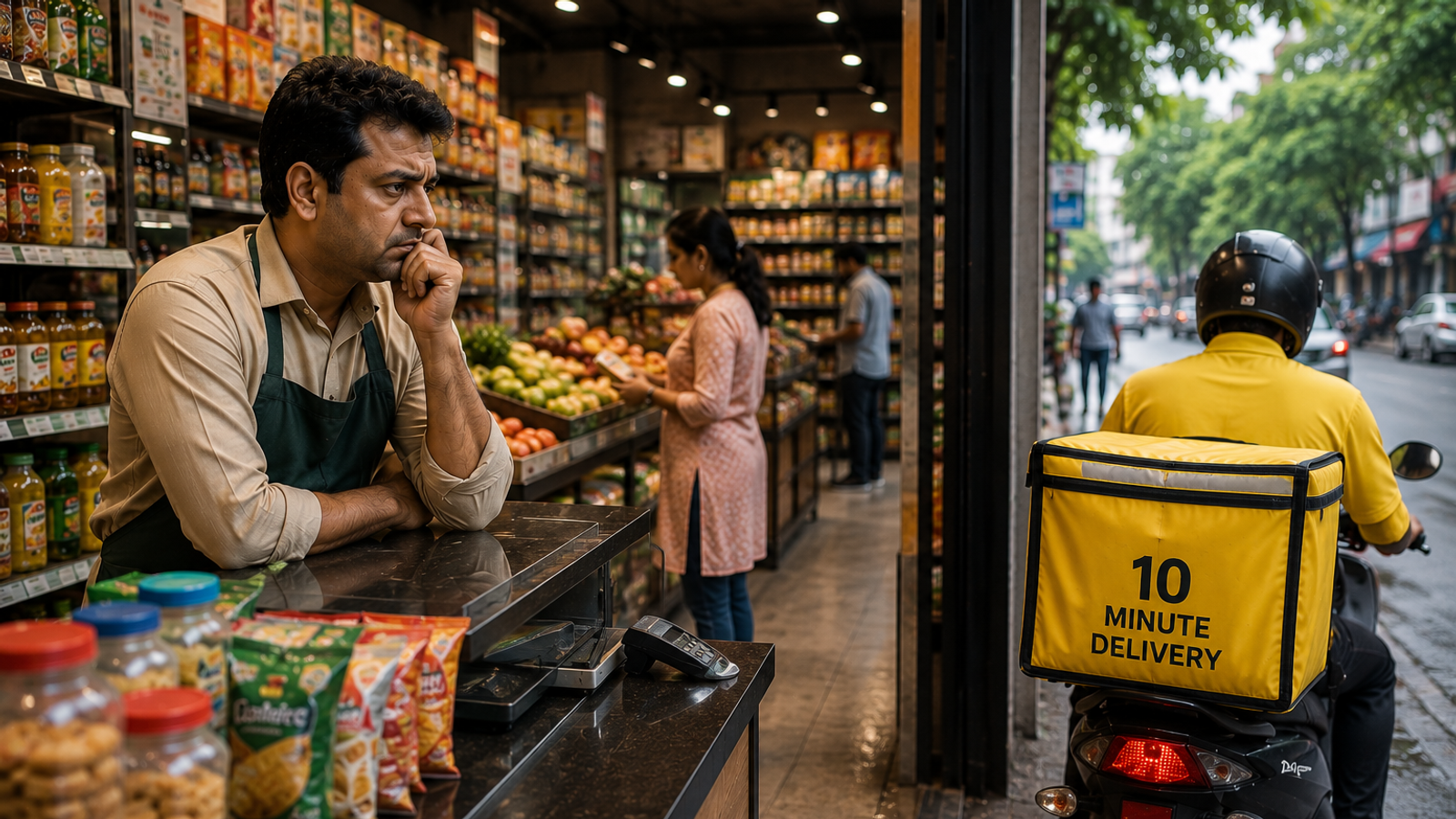
A customer who walked into your shop every single day for six years now opens an app instead. Same dal, same atta, same packet of Parle-G — but it arrives at her door in ten minutes, and you never even know she stopped coming.
This is happening in thousands of Indian grocery stores right now, and most owners only notice it after the monthly numbers quietly slide for the third month in a row. The good news: the problem is well understood, and the fix does not require you to become a tech company or hand 30% of every order to a middleman.
Let's break down exactly what's happening — and then exactly what to do about it.
The numbers nobody wants to look at
Quick commerce — Blinkit, Zepto, Swiggy Instamart, Flipkart Minutes — has gone from a curiosity to a real channel in under four years. India's quick commerce gross order value reached roughly $7.4 billion by FY25, a roughly 24-fold jump from 2022, and the market is projected to keep climbing through 2031.
Here is the part that should worry every grocery owner: surveys show that 46% of quick commerce buyers have reduced their purchases from kirana shops, and 82% have shifted at least a quarter of their kirana spending to digital platforms. Industry bodies have reported around 200,000 kirana closures in a single year, with metro cities taking the hardest hit.
But — and this matters — kirana stores still command roughly 90%+ of India's total grocery market. You are not losing a war. You are losing a slice, and it's a specific, identifiable slice. Once you understand which customers you're losing and why, you can build a moat around the ones who stay and win back the ones who drifted.
Who you're actually losing (and who you're not)
The data tells a surprisingly precise story about which customers leave:
- You're losing the convenience-driven, time-poor urban shopper — the dual-income household that used to send someone down for a "missing ingredient" run and now just taps an app. These are often your higher-value, higher-frequency customers.
- You're losing the planned "top-up" order — the ₹400–₹700 basket of mid-month essentials that quick commerce captures because it's frictionless.
- You are NOT losing the mass-market daily shopper. For the 233 million low-to-mid-income households buying ₹100–₹200 baskets 10–20 times a month, quick commerce unit economics simply break. That customer is structurally yours.
So the question isn't "how do I beat Zepto on ten-minute delivery?" You won't, and you shouldn't try. The real question is: how do I stop losing my convenience-driven, higher-value customers to an app — when the only reason they left is that I never gave them an app of my own?
The three real reasons customers switch
It is almost never about price. Kiranas are often cheaper, and customers know it. It's about three frictions:
1. You're not available on a phone at 9:47 PM
Quick commerce wins the moment a customer remembers they're out of something after your shutter is down. If there's no way to order from you except walking in during business hours, you've lost every after-hours impulse.
2. There's no "reorder my usual" button
Apps remember what people bought. They make repeat ordering a one-tap habit. Your loyal customer's six years of buying history lives only in your head — and the app turned that history into a feature you can't match on a notepad.
3. No delivery, or unreliable delivery
You may already deliver via a WhatsApp message and a delivery boy on a cycle. But "message bhej do, dekh lenge" is not a system. It breaks during rush, it has no order trail, and it feels informal next to a glossy app with live tracking.
Notice what all three have in common: none of them is a pricing problem. All three are a "you're not online in a usable way" problem.
How to get them back: build your own ordering channel
Here's the strategic shift that's working for grocery owners in 2026 — and it's the opposite of fighting quick commerce on their turf.
You don't out-Zepto Zepto. You give your own customers — the ones who already know and trust your shop — a branded ordering app and website of your own. Same trusted shop, now available on their phone, with delivery, reorder, and offers. No 30% commission to anyone, because it's your channel.
This is exactly the gap Areakart was built to close. Here's what that looks like in practice:
A branded ordering app and website with your shop's name. Not a listing inside someone else's marketplace where you compete with 40 other stores — your storefront, your brand, your customers.
Commission-free. On a marketplace, a ₹500 order can cost you ₹100+ in commission and fees. On your own Areakart channel, you keep the order value — you only pay a flat subscription, regardless of how many orders flow through.
"Reorder my usual" built in. Your customers' purchase history becomes a feature you own — one-tap reordering that makes you as sticky as any app.
WhatsApp order alerts and customer data that belongs to you. Every customer who orders is a phone number and an order history you control — to send festival offers, restock reminders, and "we miss you" nudges. On a marketplace, that customer belongs to the platform.
A realistic 30-day plan to win customers back
You don't need to digitize your whole life overnight. Here's a sequence that works:
Week 1 — Stand up your channel. Set up your branded Areakart store. Load your top 100–150 fast-moving SKUs (you don't need your entire catalogue on day one — start with what sells). Set delivery radius and timings.
Week 2 — Tell the customers you already have. Put up a printed QR code at your billing counter: "Order from us anytime — scan here." Add it to your WhatsApp status. Train your counter staff to say one line: "Aap app se bhi order kar sakte ho, ghar pe aa jayega." Your existing footfall is your cheapest, highest-converting marketing.
Week 3 — Make the first order effortless. Offer a small first-order incentive (₹50 off above ₹300, or free delivery on the first order). The goal is to break the "I'll just use Blinkit" reflex once. After one good experience ordering from you, habit takes over.
Week 4 — Build the repeat loop. Use WhatsApp to send a restock nudge to anyone who ordered staples ("Aapka monthly ration order karne ka time? Tap karke 5 minute mein."). This is the muscle quick commerce uses against you — now you're using it for yourself.
The honest bottom line
Quick commerce isn't going away, and you can't beat it at ten-minute delivery. But you don't have to. The customers you're losing aren't leaving because Zepto is better than you — they're leaving because Zepto is available and you're not.
Give your own loyal customers a branded, commission-free way to order from you on their phone, and you stop the bleed where it actually starts. You already have the trust, the prices, and the relationships. The only thing the app had that you didn't was a button on a screen.
Now you can have that too.
Ready to give your customers a reason to come back? Set up your commission-free Areakart store → — your shop, your customers, your data. Live in under 24 hours, no tech skills needed.